Creating in the Midst of Overwhelm: How I'm Coping
Where I Am Right Now: How Designing Has Kept Me Steady
As the year draws to a close, things are finally slowing down after many ups and downs. It began with frequent hospital stays and appointments.
The last few months brought new symptoms that have been even more painful, overwhelming and fatiguing, and most of that time has been spent in my flat, leaving only for hospital appointments.
Slowing down hasn’t meant the uncertainty has gone. Not knowing what’s coming next has been one of the hardest parts. But through all of it, I kept designing, and this post is about both: the work I made and the difficulty I lived through alongside it.
Volunteering with Wakefield Recovery College
One of the things I’m proudest of this year is the poster I designed for World Mental Health Day, which is currently being displayed in Wakefield One Museum as part of an exhibit. I made it as a volunteer with Wakefield Recovery College, working entirely from home, which meant I could keep contributing even when I couldn’t get out.
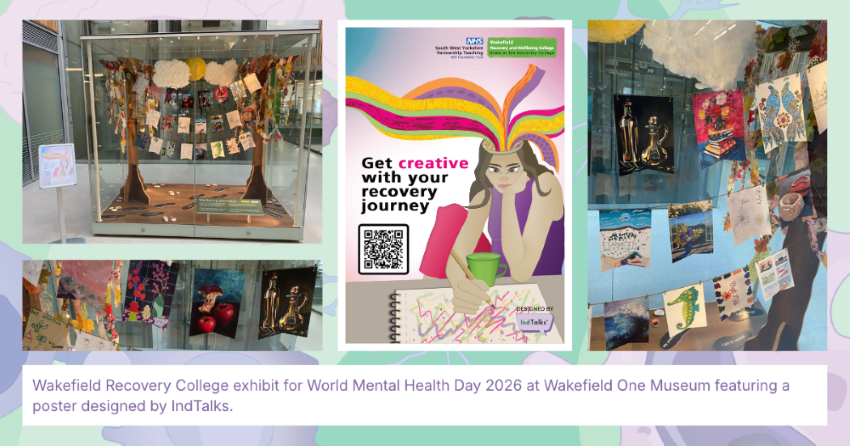
For the World Mental Health Day poster, I wanted the design to reflect creativity and thoughtfulness without leaning too far in either direction. I aimed for a tone that sat in the middle: not negative, and not overly positive. I used bright, colourful imagery to draw people in, while keeping the message open and considered, so that anyone looking at it could bring their own experience to it. I haven’t been able to see it in person, only in photographs, which has made it feel strangely distant and special at the same time.
Alongside the poster, I’ve been designing the recovery college’s newsletter each month. It’s quieter work than the poster, but the routine of it gives me something reliable to hold onto.
Designing a board game with HDRC Wakefield
The other project I’ve been part of is a board game based on research conducted by community researchers as part of the NIHR Health Determinants Research Collaboration (HDRC) Wakefield. The research explored struggles of finding work and the experience of unemployment across different populations.
I didn’t create the game itself. My role was to design the board and its six characters. Each character came with only a short description, so I used my imagination to build them out, taking care to avoid stereotypes. Giving each of them a distinct look and character was the part I enjoyed most.
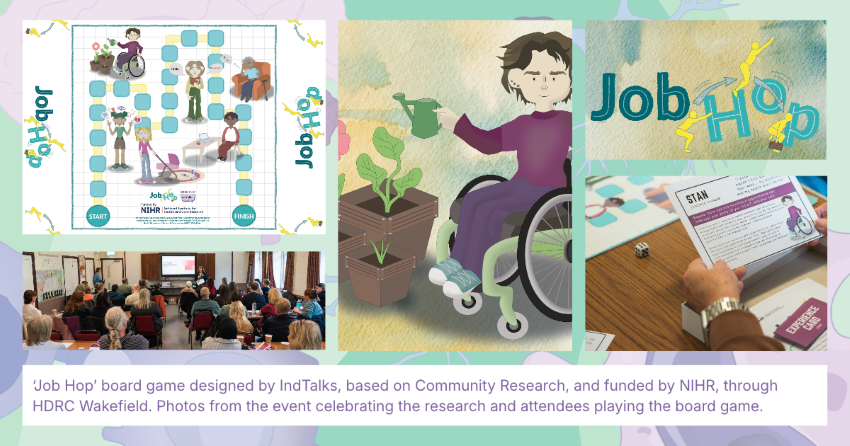
My favourite was Stan, who lives with health struggles, which I show through his wheelchair. What I loved most about him was the scene I placed him in: a gardening scene, which shows him as a whole person rather than defined by his health.
The board came together very naturally. Working from the design brief, I dotted the six characters, with their own scenes and activities, around the board in a yellow, teal and white palette.
I collaborated with the team through online meetings from home. Unfortunately I couldn’t attend the event where they celebrated the research and played the game, but I’m glad my artwork was part of it. It was a lovely change of pace from the heavier months, and a reminder of how much design can do to make research feel human and approachable.
The Unknown and the Work in Front of Me
I turned 27 this year, and for another birthday I stayed home, in pain, surrounded by my family. It wasn’t the exact birthday I’d have chosen, but I wasn’t alone in it. Making things and struggling have happened side by side this year, and neither has cancelled out the other. Designing hasn’t made the hard parts easier, but it has given me something steady to hold while they’re happening.
If you’re in the middle of something uncertain too, I hope you have something small to hold onto. It doesn’t have to be big or public to count.
Comments
Loading comments…